
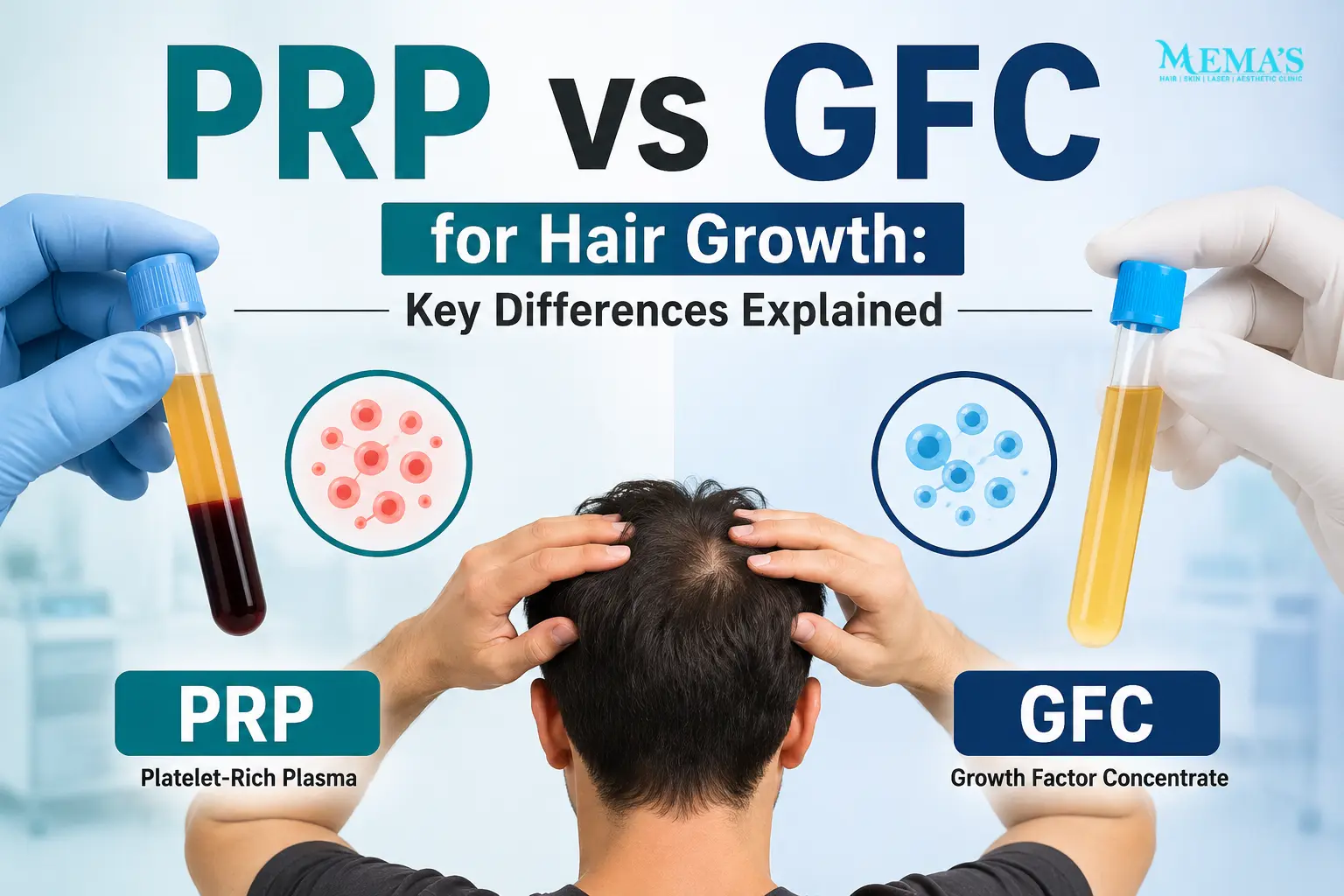
If you’ve spent any time researching hair thinning or hair loss online, you’ve probably come across two terms that seem to pop up again and again: PRP and GFC. Both are talked about as non-surgical options that work with the body’s own biology, and both are often mentioned in the same breath — which can make it genuinely confusing to understand how they’re actually different.
The short answer is: PRP and GFC are related, but they are not the same thing. They come from different starting points, involve different preparation methods, and may be considered for different reasons depending on a person’s individual condition. This article walks through what each treatment actually involves, how they compare, and what typically goes into deciding which approach might be worth discussing with a professional.
Before going further, it’s worth saying clearly: this article isn’t here to tell you that one treatment is “better” than the other, or that either one is a guaranteed fix. Hair loss is influenced by many factors, and what works — or is even appropriate — for one person may not be right for another. Think of this as a starting point for an informed conversation, not a replacement for one.
What Is PRP for Hair Growth?
PRP stands for Platelet-Rich Plasma. To understand what that means, it helps to break down what’s actually in a sample of blood.
Blood is made up of red blood cells, white blood cells, plasma (the liquid part), and platelets — small cell fragments best known for helping blood clot, but which also carry growth factors, proteins that play a role in tissue repair and cell signalling.
To prepare PRP, a small sample of a person’s own blood is drawn and placed in a centrifuge, a machine that spins the sample at high speed. This spinning separates the blood into layers based on density, allowing the platelet-rich portion of the plasma to be isolated from the red blood cells and most of the white blood cells. What’s left is a concentration of plasma with a higher-than-normal platelet count, which is then prepared for use.
The general idea behind using PRP in hair-loss management is that the growth factors present in platelets may support the scalp environment around hair follicles. It’s important to understand that PRP is derived directly from a person’s own blood, with relatively simple processing, which is one of the reasons it has been used in various medical and aesthetic fields over the years, not just for hair.
Because PRP relies on a person’s own biology, the concentration of platelets and growth factors can vary from person to person — which is one reason why individual response to PRP is not uniform. Someone’s age, general health, blood composition, and the underlying cause of their hair loss can all influence outcomes, which is why results are described as varying rather than guaranteed.
What Is GFC for Hair Growth?
GFC stands for Growth Factor Concentrate. As the name suggests, this approach is centered specifically on concentrating growth factors, rather than working with platelets in the way PRP does.
While PRP is essentially “platelet-rich” plasma, GFC preparation methods are generally designed to isolate and concentrate a broader profile of growth factors from the plasma, often using more refined separation techniques than a standard PRP protocol. The intention behind this approach is to work with a more concentrated growth-factor content, potentially with reduced red and white blood cell content compared to PRP, though the exact composition can depend on the specific preparation method used.
In practical terms, GFC may be considered as part of a hair-treatment plan in cases where a clinician feels a growth-factor-focused approach is appropriate. As with PRP, GFC is not something that is used the same way for every patient — the decision to use it, and the way it’s incorporated into a treatment plan, depends on an individual’s specific condition and the clinical judgment of the professional assessing them.
It’s also worth noting that GFC is a newer approach compared to PRP, and terminology and preparation protocols can vary somewhat between clinics. This is another reason why a proper consultation matters — it allows you to understand exactly what a specific clinic’s approach involves, rather than relying on general information alone.
PRP vs GFC: Key Differences
Here’s a side-by-side look at how the two approaches generally compare:
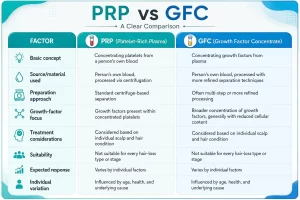
As the table shows, PRP and GFC share a lot of common ground — both work with a person’s own blood, both are associated with growth factors, and both are considered on a case-by-case basis rather than as one-size-fits-all treatments. The main differences lie in what exactly is being concentrated and how the preparation process is carried out.
PRP vs GFC: Which One Should You Choose?
This is usually the question people are really trying to answer, and the honest response is: there’s no single treatment that suits everyone. Choosing between PRP and GFC — or determining whether either is appropriate at all — is a decision best made with a qualified medical professional after a proper assessment.
Some of the factors a professional may take into account include:
- Cause of hair loss — hair thinning can stem from a variety of causes, and understanding the underlying reason matters before choosing an approach
- Pattern and extent of hair thinning — where and how hair loss is occurring on the scalp
- Existing hair density — the current condition of the hair and scalp
- Scalp condition — overall scalp health can influence treatment planning
- Medical history — including any relevant health conditions
- Previous treatments — what has or hasn’t been tried before
- Individual treatment goals — what the person hopes to achieve, and what’s realistic
Rather than picking a treatment based on what’s trending online or what a friend has tried, it’s worth having a conversation with a professional who can look at your specific situation and advise accordingly.
Are PRP and GFC Suitable for Everyone?
Not necessarily. Hair loss has many possible causes, and different causes may call for different approaches — sometimes a growth-factor-based treatment may be worth considering, and sometimes other options may be more relevant, or a combination approach might be discussed.
This is why it isn’t accurate to say that PRP or GFC works for “everyone” or for “every type” of hair loss. A proper assessment is an important step before any decision is made, and it’s something a consultation is specifically designed to address.
What Should You Expect During a Consultation?
If you’re considering exploring PRP, GFC, or hair treatment in general, a consultation is typically the first step. Here’s a general idea of what that conversation might involve:
- A discussion of your hair-loss concerns and how long you’ve noticed them
- An assessment of your scalp and hair pattern
- Questions about your medical history and any treatments you’ve tried before
- A conversation about possible treatment options relevant to your situation
- An open discussion about your expectations and goals
It’s worth keeping in mind that not every consultation will lead to a specific treatment recommendation — sometimes further evaluation is needed, and sometimes a professional may suggest an approach other than PRP or GFC altogether, depending on what they observe.
Why Professional Guidance Matters
It’s easy to feel drawn toward a treatment simply because it’s frequently discussed online or recommended by someone else’s experience. But hair loss is a personal and often multi-factorial issue, and what works well for one person’s scalp and condition may not translate the same way for another.
Professional guidance exists precisely to bridge that gap — to look past general trends and focus on your specific hair and scalp condition, your history, and your goals. That’s ultimately what makes a treatment decision more informed, rather than one based on assumptions.
About Memas Clinic
Memas Clinic offers hair and skin care services and consultations, where individuals can discuss their hair concerns and explore suitable treatment options based on their individual needs. Treatment options that may be discussed can include approaches such as PRP, GFC, and other hair-care methods where relevant — though, as covered throughout this article, not every treatment is suitable for every person, and this is something that’s assessed on an individual basis during a consultation.
If you’ve been researching PRP, GFC, or hair-loss treatment in general and would like to understand your own situation better, a consultation can be a useful next step in getting clarity.
Contact Memas Clinic
For appointments and hair consultation: 63677 77697 | 63757 51908
Locations: Jaipur | Bikaner | Agra
Frequently Asked Questions
1. What is the difference between PRP and GFC?
PRP (Platelet-Rich Plasma) involves concentrating platelets from a person’s own blood using a centrifuge, while GFC (Growth Factor Concentrate) involves a more refined process aimed at concentrating growth factors specifically. Both are derived from a person’s own blood but differ in preparation method and focus.
2. Is GFC better than PRP for hair growth?
Neither treatment is universally “better” — each may be considered depending on an individual’s hair and scalp condition, cause of hair loss, and treatment goals. A professional assessment helps determine which approach, if any, may be appropriate.
3. How does PRP work for hair loss?
PRP works by concentrating platelets, which carry growth factors, from a person’s own blood. This concentrated plasma may be used as part of a hair-loss management plan, though how someone responds can vary based on individual factors.
4. How does GFC work for hair growth?
GFC involves a more refined preparation process to concentrate growth factors from plasma. It may be considered as part of a treatment plan depending on a person’s specific condition and a clinician’s assessment.
5. Can everyone with hair loss undergo PRP or GFC?
No. Suitability depends on the cause and pattern of hair loss, scalp condition, medical history, and other individual factors. A proper consultation and assessment is needed before determining if either treatment is appropriate.
6. How do I know whether PRP or GFC is suitable for me?
The only reliable way to know is through a consultation with a qualified professional who can assess your hair and scalp condition, understand your medical history, and discuss your goals before making any recommendation.
7. Where can I get a hair consultation?
You can reach out to Memas Clinic, with locations in Jaipur, Bikaner, and Agra, to schedule a hair consultation and discuss your specific concerns.